
Landscaping Services in Nasugbu, Batangas
Punta Fuego, Terrazas, Kawayan Cove, Tali Beach, and Hamilo Coast all sit inside one municipality, within about 20 minutes of each other and roughly two hours from Manila via the Ternate-Nasugbu Highway.
We’ve completed several projects inside Peninsula de Punta Fuego and work across the surrounding communities. Coastal landscaping here is a different job from inland work: salt-laden wind off the West Philippine Sea, sandy soil that won’t hold water, a six-month dry season, and owners who are usually somewhere else when the plants need attention.
Communities & Properties We Serve
Peninsula de Punta Fuego
This is where most of our Nasugbu work has been, across Long Beach Drive, Peninsula Drive, and Punta del Sol.
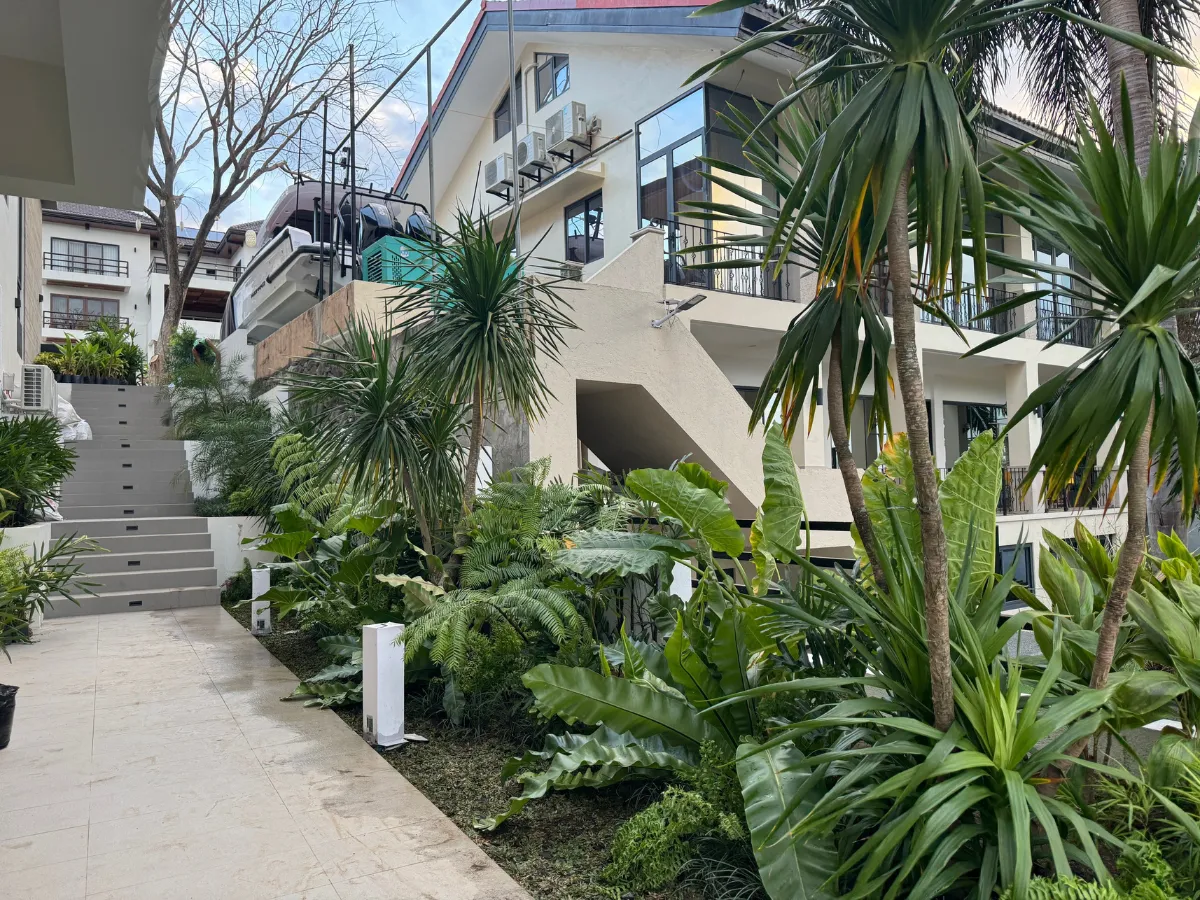
Recent project: A wind-tolerant tropical garden in Peninsula de Punta Fuego. About 150 sqm across 3 to 4 terraced levels with a sea view.
The 88-hectare development sits on a headland with twelve white-sand beaches, anchored by Club Punta Fuego and its nine-hole executive golf course. Spanish-Mediterranean architecture throughout, which narrows the palette more than people expect. Clean lines and restrained massing suit it. Dense tropical layering fights it.
The design constraint that comes up on every Peninsula lot is the view. Almost every property is bought for a specific sightline, and the fastest way to devalue one is to plant something that reaches four metres in front of it. We work to a height budget per zone and set it with the owner before anything goes in the ground.
Terrazas de Punta Fuego
Landco’s second Punta Fuego development, and home to Club Punta Fuego’s Beach Club. Terrazas lots run up the slope, which means the same salt and wind exposure as the Peninsula plus a grading problem on most properties.
Sloped coastal lots lose topsoil fast. Retaining, terracing, and planting that binds the bank matter more here than ornamental choices, and they need designing together rather than one after the other.
Kawayan Cove
A private seaside community next to Terrazas, sold as lots rather than finished houses. That means owners are commissioning architects and building from scratch, and landscape gets specified alongside the house rather than added afterward.
That’s the better way to do it. Drainage, irrigation lines, and soil replacement are cheap before the hardscape goes down and expensive after.
Tali Beach
A gated village in Barangay Balaytigue with several private beaches, a mini marina, a cliff park, and pickleball and basketball courts. Lots are large and a good number still sell bare, so there’s ongoing new-build work here.
Tali is also where a lot of Nasugbu’s short-term rental supply sits. Plenty of owners list their houses, and that changes what the landscape has to do.
For rental properties, we design to the listing, not just the lot:
- The garden has to hold up in a wide shot from the pool deck or lanai, because that’s the photo people book from
- Maintenance runs on the booking calendar, not the growing season. We schedule around turnover gaps so guests never arrive to a crew on site
- Nothing that drops litter into a pool, nothing thorny or sappy where guests walk barefoot, nothing that needs the owner present to manage
- Outdoor lighting gets specified properly. It carries the evening photos, and it’s the thing guests mention when it’s missing
The practical difference: a private garden is judged by the owner standing in it a few weekends a year. A rental garden is judged by strangers in photos, every week, and it shows up in the reviews.
Hamilo Coast
SM Prime’s 5,900-hectare estate covers 13 coves and 31 kilometres of coastline. Most of Pico de Loro Cove is mid-rise condominiums, where landscaping is the association’s job rather than the owner’s.
The parts we work with are the horizontal ones. Sola at Pico de Loro is a lot-only enclave where owners build their own homes, and Papaya Cove is opening up the same way. Those are private gardens with private budgets, and the design brief is different from a condo grounds contract.
Working Inside Gated Communities
Most of the friction on a Nasugbu project isn’t the design. It’s getting a crew and a truckload of plants through the gate.
Peninsula de Punta Fuego and Tali Beach both require work permits filed ahead of time, with named workers and dated access windows. Deliveries have restricted hours. Some communities won’t admit contractor vehicles on peak weekends at all.
We’ve been through that process on the Peninsula, so the paperwork happens before the crew is booked instead of after they’ve been turned away at the gate. Ask any owner who has hired an unfamiliar contractor how that first week went.
Emerging Developments
Two large projects are underway, and they sit on very different timelines:
- Ayala Land’s Arillo Estate (62 hectares) in Batulao. Mixed-use, featuring Seda’s first mountainside resort, retail, and residential. Groundbreaking was December 2023, the leisure centre and El Kabayo are already operating, and the Blue Leaf events venue is due in 2026. This is the near-term one.
- Megaworld’s Nascala Coast (116 hectares). A beachside township. Villa Scala, its first village at 18 hectares and 217 lots, completes in 2032, with sales running to the same year. Occupancy is well beyond that, so treat it as a long horizon rather than a pipeline.
Services We Offer in Nasugbu
Landscape Design
Designs suited to Nasugbu’s coastal environment. We select salt-tolerant plants, account for the direction the wind and spray actually come from, and create landscapes that deliver resort aesthetics while surviving beachfront conditions.
Learn more about our design services →
Landscape Construction
Installation adapted to coastal realities: sandy soils, salt exposure, and wind patterns. Our teams understand how to prepare sites and select materials that perform in seaside environments.
Learn more about our construction services →
For beach resorts and hotels, see resort and hotel landscaping, and for a private resort built from a bare lot, private resort design and build.
Garden Maintenance
Nasugbu is warm enough to grow year-round, but only where irrigation is guaranteed. Without it the six-month dry season stops growth and starts losses. Our maintenance programmes adjust for salt spray, shift with the wet and dry seasons, and coordinate with property caretakers for vacation homes.
Learn more about maintenance programs →
Landscaping in Nasugbu: What to Consider
Coastal Conditions
Salt spray, sandy soils, and sea winds define Nasugbu landscaping. Plants that thrive inland may struggle here. We plant what actually holds up in Philippine coastal conditions: bantigue, talisay, botong, beach naupaka, coconut and Manila palm, beach morning glory, malubago, and bougainvillea.
Which Way the Weather Comes From
Nasugbu faces the West Philippine Sea, so its exposure runs opposite to the east-coast Batangas towns.
- June to September, the southwest monsoon drives rain and swell straight onto the coast from the west and southwest. That’s where salt spray lands hardest.
- December to February, the amihan reverses that: sustained wind arrives from the northeast, over land rather than off the water.
Practically, that means salt-tolerant screening goes on the west and southwest faces, tender and broad-leaved material goes on the northeast side, which is sheltered from salt spray rather than from wind, and staking gets specified for the amihan months as well as for typhoon season. Most generic coastal advice gets this backwards because it’s written for the Pacific side.
Resort-Quality Expectations
Nasugbu’s exclusive communities set high standards. Landscapes must photograph beautifully, complement architectural design, and hold their appearance through both seasons. We design and maintain to these expectations.
Vacation Property Reality
Most Nasugbu properties serve as weekend retreats or vacation homes, so the landscape has to look good between visits, not just on the day it’s installed. Automated irrigation, resilient plant selection, and low-maintenance design are essential.
View Preservation
Beachfront properties exist for the ocean view. Landscape design should frame rather than block sightlines: strategic layering, appropriate plant heights, and view corridors that enhance the coastal panorama.
Climate & Growing Conditions
Coastal Climate
Nasugbu sits in PAGASA’s Type I climate. Two sharp seasons, and the split is the whole design problem:
- Dry: November to April. February is the driest month, at roughly 25mm across two rainy days.
- Wet: May to October, peaking July.
- Annual rainfall: roughly 2,400mm, with nearly all of it in six months
- Temperature: averages around 27°C, warmest in April
So Nasugbu isn’t dry. It’s a wet place with a long drought in the middle, and coastal sand holds almost none of that water when the rain stops. A garden that looks established in October can be dead by April without irrigation.
This is why we spec automated irrigation on nearly every Nasugbu property. It isn’t an upsell. It’s the difference between a landscape that survives its first summer and one that gets replaced.
Terrain Variation
Nasugbu runs from sea level to mountain. The beach communities sit just above sea level, inland barangays climb through the Batulao foothills, and Mt. Batulao itself tops out at 811 metres. That range means real microclimate differences across one municipality, and a palette that works on the coast is not the palette for a Batulao-facing lot.
Flood Considerations
Low-lying coastal barangays face flood risk during heavy rains and storm surge. We design with drainage in mind and select plants that tolerate occasional waterlogging where appropriate.
Best Planting Window
- Best for planting: late May to July, as the rains arrive. Roots go down while water is free, and stock is established before the next dry season.
- Best for hardscape: November to April. Dry ground, no washouts, and pool decks and paving cure without waiting on the weather.
- Workable year-round with irrigation. Nasugbu is warm enough to plant any month, but only if the water is guaranteed. Without a system, a March planting is a gamble.
- Avoid: August and September for major installations. Saturated sand won’t compact, and anything not yet anchored is exposed to storm swell.
Our Design Approach
Design Styles We Specialize In
- Tropical resort. Lush, layered plantings that create private paradise atmospheres
- Coastal minimalist. Clean lines, strategic palms, ocean-inspired palettes
- Balinese-inspired. Water features, stone elements, tropical sanctuary design
- Japanese-inspired. Zen gardens suited for meditation and retreat properties
Hardscape Services
- Pool deck landscaping and surrounds
- Outdoor entertaining areas and cabanas
- Paver installation and beach-access pathways
- Artificial turf for salt-exposed areas where natural grass struggles
Common Nasugbu Requests
- Beachfront landscapes with salt-tolerant plant selection
- Privacy screening between neighboring properties
- Resort-style pool surrounds with tropical plantings
- Low-maintenance designs for vacation homes
- View-framing rather than view-blocking layouts
Notable Nasugbu Landmarks
Caleruega Church
The Transfiguration Chapel at Caleruega sits atop a hill in Barangay Batulao, surrounded by manicured grounds, koi ponds, and gardens. Most people place it in Tagaytay; it’s in Nasugbu. It’s also a working demonstration of what thoughtful landscape design does with this terrain.
Mt. Batulao
Rising 811 metres with 12 peaks, Mt. Batulao offers panoramic views of Taal Lake, the Nasugbu coastline, and the surrounding mountains. Properties in the Batulao foothills, including Ayala’s Arillo Estate, get cooler temperatures and different growing conditions than the coast.
Fortune Island
This small island off Nasugbu’s coast, with its Greek Acropolis replica, is a reminder of the area’s appeal for distinctive, high-end development.
Getting to Nasugbu
From Manila
- Via CAVITEX and the Ternate-Nasugbu Highway: the fast route, roughly two hours. Through the Kaybiang Tunnel and along the coast into Barangays Looc, Calayo, and Balaytigue. This is the one most owners use.
- Via CALAX and Tagaytay: exit at Silang, through Tagaytay, then the descent to the coast. Around 2.5 to 3 hours. Slower, but it’s the route if you’re combining the trip with anything in Tagaytay or Batulao.
- Via STAR Tollway and Balayan: the long way around, but it avoids the Tagaytay weekend crawl entirely.
From Santa Rosa
From our base, Nasugbu is approximately 1.5 to 2 hours via Tagaytay depending on traffic.
Traffic Reality
Weekend traffic to Nasugbu’s beach destinations can be heavy, particularly during summer months and holidays. We schedule site visits and deliveries to avoid peak congestion.
Plant Sourcing for Coastal Properties
We source from suppliers experienced with coastal-appropriate plants:
- Salt-tolerant palms. Coconut, Manila palm (Adonidia merrillii, also sold as Christmas palm), fishtail
- Coastal trees and shrubs. Bantigue (Pemphis acidula), talisay (Terminalia catappa), botong (Barringtonia asiatica), beach naupaka (Scaevola taccada), malubago (Hibiscus tiliaceus)
- Ground covers. Beach morning glory (Ipomoea pes-caprae), zoysia matrella for salt-exposed lawn
- Accent plants. Bougainvillea, crotons, ti plants. Bird of paradise and heliconia only in sheltered positions with irrigation, since both burn in salt wind
For specimen plants and specialty items, we source from the Laguna nursery belt and arrange proper transport to ensure plants arrive healthy despite the coastal destination.
Halamanan Landscape Studio is not affiliated with, endorsed by, or an accredited contractor of Landco Pacific, SM Prime, Ayala Land, Megaworld, or the homeowners' associations of the communities named on this page. Community and estate names are used for locational reference only.
Common Questions
What makes Nasugbu different for landscaping?
Two things. Wind direction. Salt-laden air comes off the West Philippine Sea from the west and southwest through the habagat, and from December to February the wind reverses to a sustained northeast that arrives over land rather than off the water. And sandy coastal soil that holds almost no water through a six-month dry season. We select salt-tolerant species, site the tender material on the northeast face, which is sheltered from salt spray rather than from wind, and stake it for the amihan months. Irrigation gets specified on nearly every property.
Do you work with the gated communities in Nasugbu?
Yes. Most of our Nasugbu work has been inside Peninsula de Punta Fuego, and we work across the surrounding communities including Terrazas de Punta Fuego, Kawayan Cove, Tali Beach, and the horizontal lot developments inside Hamilo Coast. We file work permits and schedule deliveries to each community's access rules before a crew is booked.
What about landscaping for beach houses and vacation homes?
Many Nasugbu properties are weekend retreats, and a good number are also short-term rentals. We design low-maintenance, salt-tolerant landscapes with automated irrigation that hold up unattended, and for rental properties we schedule maintenance around the booking calendar rather than the growing season.
Do you offer maintenance services in Nasugbu?
Yes, we provide maintenance programs throughout Nasugbu. For vacation properties, we offer caretaker-friendly schedules that keep your landscape presentable between visits.
Start Your Nasugbu Project
Get a free consultation and estimate for your landscape project.
Get Your Free Estimate