
Vertical Garden & Green Wall Installation
Custom living walls and green wall systems across Luzon. Modular and custom-framed installations with a 30-day plant establishment guarantee.
Custom living walls and green wall systems for homes, restaurants, offices, and commercial spaces. Past projects across Metro Manila, Cavite, Laguna, and Batangas, serving the entire Luzon region. Every install includes a 30-day plant establishment guarantee.
- residential from
- ₱8,500
- small commercial
- ₱9,000
- mid-market
- ₱11,000
Per square meter, including framing, plants, irrigation, and 30-day plant establishment guarantee
Vertical Garden Cost in the Philippines
Installation cost ranges from ₱8,500 to ₱15,000 per square meter, including design, modular framing, plant selection, irrigation system, and a 30-day plant establishment guarantee. Maintenance and plant replacement after the establishment period are quoted separately.
| Project type | Typical size | Price range per sqm | Total project range |
|---|---|---|---|
| Residential (balcony, accent wall, façade) | 2-12 sqm | ₱8,500 to ₱10,000 | ₱17,000 to ₱120,000 |
| Small commercial (restaurants, cafés, retail, small offices) | 4-30 sqm | ₱9,000 to ₱12,000 | ₱36,000 to ₱360,000 |
| Mid-market commercial (offices, hotels, condos, mall fitouts) | 30+ sqm | ₱11,000 to ₱15,000 | ₱330,000+ |
What affects your final cost
Pricing varies based on a few real factors:
- Wall size and access difficulty. A ground-level 6 sqm wall is simple. A 4-storey façade install with scaffolding is not.
- Plant selection. Available light determines which species can survive. More restrictive lighting means a narrower (sometimes more expensive) plant palette.
- Irrigation system. Manual drip is the affordable baseline. Automated systems with timers and recirculation cost more upfront, save labor over time.
- Indoor vs outdoor. Outdoor walls need weather-resistant framing and UV-tolerant plants. Indoor walls often need supplemental grow lights (more on this below).
- Modular vs custom-framed. Modular systems install faster. Custom welded frames cost more but suit irregular wall shapes.
What to Expect From a Living Wall
Most green wall providers gloss over this. We’d rather you know upfront, because the clients who go in with the right expectations end up with the best walls.
A vertical garden is a living planting, not a static installation
Think of a vertical garden the way you’d think of an aquarium or a real garden, not the way you’d think of a tile feature or a painting. It’s alive. It changes. That’s actually part of what makes it beautiful: a real wall that breathes, grows, and shifts subtly with seasons. The alternative (artificial walls) is the trade-off.
Here’s what the change looks like in practice:
- Some plants will thrive beyond what we planted. A pothos that started as a small cell can become a cascading 2-meter feature within 8-10 months. We prune these back to keep design balance, or sometimes let them take over a section if it works.
- Some plants will struggle and need replacement. Even on well-designed, well-maintained walls, 5-15% of the original plants typically don’t take in the first 1-3 months. Some don’t adapt to the substrate, the light, or the irrigation, no matter how carefully selected. This is normal mortality, and our 30-day establishment guarantee covers replacement of plants we specified that don’t take.
- Most plants will outgrow their cells in 12-18 months. Substrate volume in a vertical wall is genuinely constrained, much smaller than a regular pot. Roots fill the cell, growth slows, and the plant gets reset, replaced with a fresh specimen of the same species, or rotated for variety.
- The overall wall stays beautiful through this turnover because we manage it. A wall that looks the same as the day we installed it isn’t possible. A wall that looks beautiful, healthy, and full at year 1, year 3, and year 5 is, with proper maintenance.
If you’re picturing a vertical garden as something you install once and admire unchanged for years, we’d suggest looking at artificial walls instead, since they actually deliver that. If you’re picturing a wall that’s alive and evolves with your space, a vertical garden is the right product, and these dynamics are part of what you’re paying for.
Indoor walls are harder to maintain than outdoor walls
Plants need light. Most Philippine indoor spaces, even bright-looking ones, deliver far less usable light than the human eye registers. Without supplemental grow lighting at sufficient intensity (typically 2,000+ lumens directed at the wall, often more), plants stretch toward windows, drop leaves, and fail within 3-6 months.
If you want an indoor vertical garden, budget for grow lights from day one. We’ll spec the lighting needs alongside the wall during design, not after problems appear.
Low-light walls have an overwatering risk most installers ignore
Low light doesn’t just mean slower growth. It means the substrate dries slower too. Standard irrigation schedules calibrated for bright walls will drown a low-light wall, causing root rot, fungal issues, and rapid plant death.
We adjust irrigation frequency and emitter flow based on light conditions, not on a fixed schedule. If you’ve had a previous indoor wall fail with what looked like “too much water,” this is almost certainly why.
Afternoon-sun walls are harder than they look
A west-facing wall (full afternoon sun, hottest exposure) is one of the most challenging conditions in the Philippines. Surface temperatures can hit 50-60°C, and the plant palette that survives this consistently is genuinely small: hardy succulents, certain bougainvillea cultivars trained as walls, lantana, ornamental grasses, and a handful of native shrubs.
If your wall faces west and you want a lush, varied look, expect either a higher failure rate, more frequent plant replacement, or shade structures (pergolas, screens) added to soften the exposure. We’ll be straight with you during the site assessment if your wall is in this category.
High-rise façades are very hard to maintain unless designed for it
If you’re considering a vertical garden on a building façade above 3 storeys, the maintenance question matters more than the install question.
Buildings designed from the start with green wall maintenance in mind have catwalks, anchor points for rope access, gondola compatibility, or planned scaffold tie-ins. Buildings without these features turn every maintenance visit into a major operation: scaffold rental, permits, safety crews, and potentially weeks of lead time for what should be a 2-hour pruning visit.
We’ve seen façade walls become abandoned eyesores within 18-24 months because nobody priced the maintenance access correctly during design. Before you commit to a high-rise façade install, the access plan needs to be solved. Otherwise, the wall will look great for a year and then slowly fail in public view, which is worse than not installing one at all.
What lasts and what doesn’t
To be precise about lifespan:
- The system (framing, irrigation lines, mounting hardware, wall structure): 5-10+ years with proper maintenance.
- The plants: in continuous turnover from month one. Some die early, some thrive, all eventually outgrow their cells in 12-18 months.
- The overall look: can be maintained beautifully for years through ongoing replacement and pruning. The wall keeps looking good because we keep replacing what isn’t working, not because the original plants stay forever.
Plant selection depends entirely on your wall’s sun exposure
Quick orientation guide:
- East-facing (morning sun, afternoon shade): Part-shade tropicals. Ferns, anthuriums, pothos varieties. Good middle ground for plant variety.
- West-facing (afternoon sun, hottest exposure): Full-sun, heat-tolerant only. Limited palette. Surface temperatures often hit 50°C+.
- South-facing (most sun all day): Full-sun species. Native shrubs, ornamental grasses, hardy succulents.
- North-facing (least sun): Full-shade tropicals. Selaginella, ferns, philodendrons, peperomias. Watch for overwatering.
- Indoor (any orientation): Low-light tolerants plus supplemental grow lighting. Reduced irrigation frequency.
We do a site assessment before specifying any plant palette, because real walls rarely match clean compass-direction examples.
Three Service Tiers
Residential
Typical projects: balcony accent walls, garden focal walls, courtyard façades, patio screens, condo unit feature walls.
- Project size: 2 to 12 sqm
- Price range: ₱8,500 to ₱10,000 per sqm
- Typical total: ₱17,000 to ₱120,000
Small Commercial
Typical projects: restaurant feature walls, café accent walls, retail storefront greenery, small office lobbies, salon and clinic interiors.
- Project size: 4 to 30 sqm
- Price range: ₱9,000 to ₱12,000 per sqm
- Typical total: ₱36,000 to ₱360,000
Mid-Market Commercial
Typical projects: corporate office lobbies, hotel lobbies, condo amenity walls, mall fitouts, building façades (with maintenance access planned).
- Project size: 30+ sqm
- Price range: ₱11,000 to ₱15,000 per sqm
- Typical total: ₱330,000 and up, custom quote based on scope
We work with architects, interior designers, and project managers on RFP-driven specifications. For high-rise façade projects, we’ll discuss maintenance access requirements before any install commitment. Lead times for projects above 50 sqm typically run 4-6 weeks from approved design to handover.
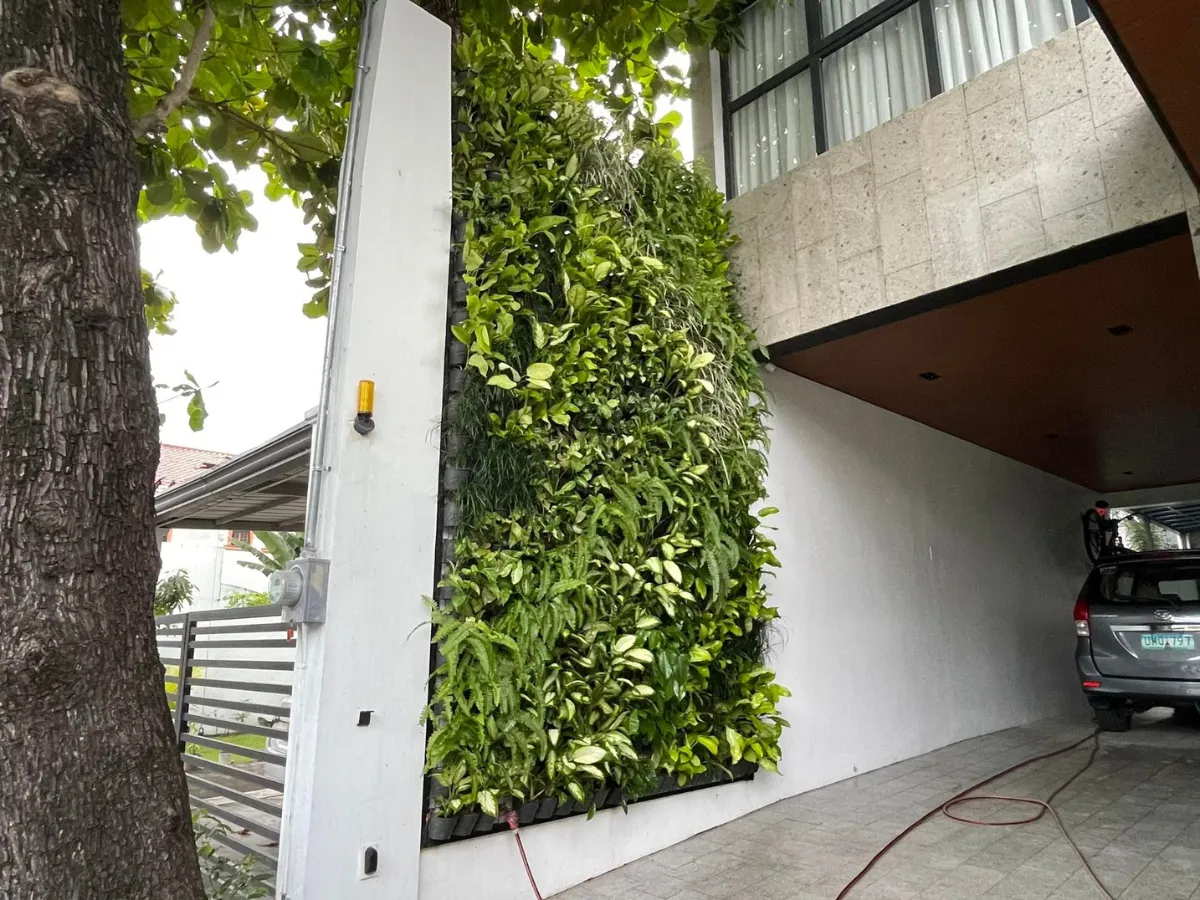
For an example, see the 20 sqm facade wall we built at The Terraces at Havila in Taytay, which was in the architects’ design from the start.
System Options
We install live plant walls. Within that category, you have two construction approaches:
- Modular systems use pre-fabricated panels. Faster install, easier plant replacement, suit standard rectangular walls.
- Custom welded frames are built on-site or to spec. Better for irregular wall shapes, curved walls, and projects where a specific aesthetic frame matters. Higher cost, longer lead time.
We recommend the right approach after assessing your wall, light conditions, maintenance budget, and use case.
What’s Included in Every Install
Standard scope:
- Site assessment and light survey
- Design and plant specification
- Wall structural prep (mounting points, waterproofing review)
- Modular framing or custom welded frame
- Plants (selected based on light conditions and design)
- Drip irrigation system (manual or automated, scoped to project)
- Installation by trained crew
- 30-day plant establishment guarantee (covers initial-establishment mortality of plants we specified, not lifetime plant warranty)
Quoted separately:
- Ongoing maintenance (monthly retainer)
- Plant replacement after the 30-day establishment period
- Grow lighting for indoor installs (specified during design, sourced separately)
- Plumbing connection for automated irrigation
- Scaffolding for installs above 3 meters
- Maintenance access infrastructure for high-rise façade installs
Maintenance and Plant Replacement
What you’re paying for in a maintenance contract isn’t “keeping the wall alive forever.” It’s managing the continuous turnover of plants while keeping the overall wall looking good.
What maintenance covers
- Weekly to bi-weekly watering check (automated systems get a system check, manual systems get hand-watered)
- Monthly fertilization (foliar spray and substrate feed)
- Quarterly plant health audit and replacement of underperformers
- Plant replacement when species outgrow their cells (typically 12-18 months per species)
- Irrigation line and emitter inspection
- Pruning aggressive species to keep design balance
- Substrate moisture testing (both dry and waterlogged substrate kill walls fast)
Plant replacement, the honest version
Most maintenance contracts include a small allowance for routine plant replacement. Larger replacement events (when a whole section needs reset, or when seasonal turnover is needed) are quoted separately.
Typical residential wall: 10-25% of plants replaced per year as part of routine turnover. Typical commercial wall: similar percentage, sometimes higher in challenging conditions (afternoon sun, high foot traffic, indoor low-light).
Maintenance contracts
- Residential: Monthly visits standard. Includes routine plant replacement within a scoped allowance. Quoted per project based on wall size and access.
- Commercial: Visit frequency scoped to wall size. Plant replacement budget scoped to project. Quoted per project.
- DIY support: A one-hour handover walkthrough and a written care guide are included with every residential install. We can also supply replacement plants on request without a full maintenance contract.
A wall on a maintenance contract stays beautiful for years through continuous management. A wall without maintenance often shows severe issues within 3-6 months, with full failure within a year.
Related Services
- Garden Maintenance for the ongoing care that keeps a vertical garden healthy past the 30-day establishment period.
- Landscape Design when the wall is part of a larger garden, courtyard, or outdoor space.
- Pool Landscaping where vertical greenery softens a pool surround or screens a service area.
Learn More
Landscaping Cost Philippines
Complete guide to landscape pricing per sqm, design fees, and what affects your budget.
Read the guide →Low-Maintenance Garden Design
Design a beautiful garden that doesn't demand constant attention.
Read the guide →Garden Privacy Ideas for Small Philippine Lots
Privacy for small PH lots without the prison-wall look: solid CHB, breeze block screens, and living fences compared, with costs, permit rules, and plant pairings.
Read the guide →Vertical Garden & Green Wall Installation Across Our Service Areas
We provide vertical garden & green wall installation throughout Metro Manila, Cavite, Laguna, Batangas, Pampanga, and Tarlac. Popular areas:
- Makati Metro Manila
- BGC/Taguig Metro Manila
- Silang Cavite
- Dasmariñas Cavite
- Santa Rosa Laguna
- Calamba Laguna
- Lipa City Batangas
- Nasugbu Batangas
- San Fernando Pampanga & Tarlac
- Porac Pampanga & Tarlac
Common Questions
How much does a vertical garden cost in the Philippines?
Installation ranges from ₱8,500 to ₱15,000 per square meter depending on plant selection, irrigation system, framing approach, and project scope. Residential projects typically run ₱8,500 to ₱10,000 per sqm. Commercial projects run ₱9,000 to ₱15,000 per sqm. Maintenance and plant replacement after the establishment period are quoted separately.
How long does a vertical garden last?
The system (framing, irrigation, mounting) lasts 5-10+ years with proper maintenance. The plants are in continuous turnover from month one. Expect 5-15% early mortality in the first few months, and routine plant replacement at the 12-18 month mark as species outgrow their cells. A maintained wall stays beautiful for years through ongoing replacement, not because the original plants stay forever. A wall without maintenance often fails within 6-12 months.
Will some of my plants die?
Yes, almost certainly. Some plants don't adapt to the substrate, the light, or the irrigation, no matter how carefully selected. 5-15% early mortality is normal even on well-maintained walls. The 30-day establishment guarantee covers initial replacement of plants we specified that don't take. After that period, plant replacement is part of ongoing maintenance.
Do vertical gardens work outdoors in Philippine weather?
Yes, with the right plant selection. Outdoor walls in the Philippines need UV-tolerant, heat-tolerant species and weather-resistant framing. Wind exposure matters too: walls above 2 storeys need wind-rated framing. Afternoon-sun walls (west-facing) are the most challenging exposure and require a limited palette of heat-tolerant plants. We assess all of this during the site survey.
Do vertical gardens work indoors?
Yes, but lighting is the deciding factor. Most indoor spaces don't deliver enough light for plant survival without supplemental grow lights. Low-light installs also need carefully tuned irrigation since the substrate dries slower and plants are easily overwatered. If you want an indoor wall, budget for both lighting and a maintenance contract from the start.
Can I install a vertical garden on a high-rise building façade?
Yes, but only if maintenance access is planned. Façades on buildings above 3 storeys need catwalks, rope-access anchor points, gondola compatibility, or scheduled scaffold tie-ins. Without these, every maintenance visit becomes a major operation, and most façade walls without proper access end up failing publicly within 18-24 months. We'll discuss access requirements before any high-rise commitment.
What plants are best for vertical gardens in the Philippines?
It depends entirely on your wall's light conditions. Common reliable performers include philodendrons, pothos varieties, anthuriums, ferns, peperomias, and selaginellas for shade walls. Bougainvillea (trained), succulents, lantana, and ornamental grasses suit full-sun walls. West-facing afternoon-sun walls have the most limited palette. We specify the plant palette only after assessing your specific site.
How long does installation take?
Residential walls (under 12 sqm) typically install in 2-3 days after design approval. Small commercial (12-30 sqm) takes 5-7 days. Mid-market commercial (30+ sqm) takes 2-4 weeks. Lead time from inquiry to installation start is usually 3-4 weeks for residential, 4-6 weeks for commercial, depending on plant availability and structural prep.
Do you offer maintenance contracts?
Yes. Monthly visits for residential, frequency scoped to wall size for commercial. Contracts include routine plant replacement up to a scoped allowance. Larger replacement events are quoted separately. We also offer DIY support: a one-hour handover walkthrough and a written care guide included with every install for residential clients who prefer to maintain themselves.
Can I install a vertical garden myself?
Possibly, for small residential walls under 4 sqm. The risks are picking the wrong plants for your light conditions, undersizing or oversizing irrigation, or mounting the frame onto a wall that can't support the loaded weight. A loaded green wall can weigh 60-100 kg per square meter when fully irrigated. If you DIY, factor structural review and irrigation design carefully. You'll also be doing your own plant replacement, which is the ongoing reality of owning a vertical garden.
What's the difference between a green wall and a vertical garden?
Same thing, different terms. 'Green wall' is more common in commercial and architectural contexts. 'Vertical garden' is more common in residential and gardening contexts. 'Living wall' is sometimes used to specifically mean live plant systems. We use all three interchangeably.
What areas do you serve?
The entire Luzon region. Most projects to date have been in Metro Manila, Cavite, Laguna, and Batangas. Projects outside these areas may include travel and accommodation costs depending on distance and project size.
Start Your Project
Ready to get started? Get a free consultation and estimate.
Prices on this page are per square meter, including framing, plants, irrigation, and the 30-day plant establishment guarantee. Maintenance and plant replacement after the establishment period are quoted separately.