
Canary Island Date Palm
Phoenix canariensis
Also known as: Canary Date Palm, Pineapple Palm
HNW residential and resort statement specimen with mediterranean character. Direct supply at 5 ft to 12 ft trunk heights using a ₱2,000/ft formula. Architect-specified for hotel entrances and corporate campus arrivals.
Pricing Guide (per palm)
| Size / Spec | Price (PHP) |
|---|---|
| 5 ft trunk | ₱18,000–₱22,000 |
| 7 ft trunk | ₱24,000–₱30,000 |
| 10 ft trunk | ₱34,000–₱40,000 |
| 12 ft trunk | ₱40,000–₱48,000 |
Volume Discounts
- 5–10 palms:5%
- 11–25 palms:8-10%
- 26+ palms:Project-specific pricing
Pricing follows the ₱2,000/ft trunk formula. Trunk height (not total palm height) is the spec; crown adds 5-7 ft above the trunk. Delivery, crane installation, and 30-day establishment service quoted separately. Volume discounts apply at 5+ palms.
Request Project Quote →About Canary Island Date Palm
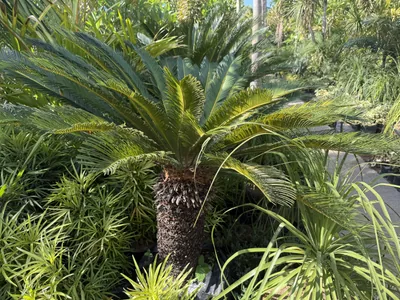
The Canary Island Date Palm (Phoenix canariensis) is the most architecturally distinctive palm in landscape use globally. Native to the Canary Islands off the African coast, the species develops a dramatic pineapple-shaped trunk base from old leaf scars, a thick robust trunk, and a dense crown of stiff arching fronds. In Philippine landscape supply, we cap sourced specimens at 12 ft trunk, the practical ceiling for transport and predictable supply. Architect-specified for HNW residential, resort statement plantings, and hotel arrival landscapes.
Common Applications
- HNW residential entrance specimens. Single 7-10 ft trunk specimen at executive home entrance, or paired flanking driveways.
- Hotel and resort arrival landscapes. Lobby drop-off zone anchors, signature view focal points. 10-12 ft trunk tier at premium positioning.
- Corporate campus and embassy formal landscapes. Where landscape signals institutional permanence and mediterranean character.
- Country club landmark plantings. Clubhouse approaches, signature golf course locations, exclusive subdivision entrances.
- Heritage estate and architectural focal points. Multi-decade landscape investments at properties expecting multi-generation tenure.
- Pool and water-feature surrounds. Pool-safe with relatively clean leaf drop. Plant 5-7 m from pool edge for clearance.
- Mediterranean-style garden compositions. Pairs with stone hardscape, agave, olive, and citrus in Mediterranean-themed Philippine residential.
Where You'll See It
- Premium residential entrances in Forbes Park, Dasmariñas Village, and Tagaytay highlands
- Hotel and resort arrivals across Boracay, Coron, Bohol, and Tagaytay
- Country club landmark plantings in CALABARZON
- Corporate campus and embassy formal landscapes in Manila
- Mediterranean-themed Tagaytay and Subic residential developments
Why Architects Choose It
- Distinctive pineapple-shaped trunk base, the species' calling card; develops over decades and reads as deliberate architectural investment
- Architect-specified for projects requiring mediterranean character or HNW residential statement plantings
- Drought-tolerant and salt-tolerant once established, with minimal ongoing maintenance overhead
- Multi-decade landscape investment; 50+ year specimens are common and the cost amortizes over property lifetime
- Pairs with modern, traditional Mediterranean, and tropical-formal architecture without competing visually
Project Types Best Suited
- HNW residential gardens
- Boutique and premium resort landscapes
- Hotel arrival statements
- Country club landmark plantings
- Embassy and government residence landscapes
- Heritage estate landscape investments
- Mediterranean-style residential developments
- Corporate campus formal landscapes
Specifications
- Botanical name
- Phoenix canariensis
- Family
- Arecaceae
- Native range
- Canary Islands (Spain)
- Sourced trunk height range
- 5 ft to 12 ft
- Mature trunk height (in habitat)
- 10-20 m
- Trunk diameter (mature)
- 1.0-1.3 m at pineapple base
- Crown spread (mature)
- 5-6 m
- Defining feature
- Pineapple-shaped trunk base from old leaf scars
- Growth rate
- Slow (cultivation 20-50 years for full character)
- Sun
- Full sun
- Water
- Low; drought-tolerant once established
- Pool safe
- Yes (plant 5-7 m from pool edge)
- Salt tolerant
- Yes
Canary Island Date Palm (Phoenix canariensis) Supplier. B2B
The Canary Island Date Palm (Phoenix canariensis) is the architectural specimen palm of Philippine HNW residential, resort, and corporate landscape design. Native to the Canary Islands off the African coast, the species has been cultivated in Mediterranean, Californian, Australian, and tropical landscapes for over a century because the form and presence develops with a character no other readily-grown palm matches.
The defining feature is the pineapple-shaped trunk base that develops from accumulated old leaf scars over decades. A mature Phoenix canariensis presents a thick robust trunk, a dramatic pineapple base often 1.0-1.3 m wide, and a dense crown of stiff arching fronds spanning 5-6 m.
The 12 ft Sourcing Ceiling and ₱2,000/ft Pricing
Pricing follows a clean ₱2,000/ft trunk formula:
- 5 ft trunk: ₱18,000-22,000
- 7 ft trunk: ₱24,000-30,000
- 10 ft trunk: ₱34,000-40,000
- 12 ft trunk: ₱40,000-48,000 (max)
12 ft trunk is the practical sourcing ceiling. Larger specimens (15+ ft) are rare in Philippine commercial supply, require oversized-load permits and escorted transport, and the survival risk on transplanting larger Phoenix specimens is significant. For projects needing more vertical scale, Royal Palm (up to 14 ft trunk) is the better commercial substitute.
Trunk Height vs Total Palm Height
Phoenix canariensis pricing is by trunk height (the smooth columnar portion above the pineapple base, ground to crownshaft). The crown adds approximately 5-7 ft above the trunk. So a 5 ft trunk specimen presents at roughly 10-12 ft total visible height; 12 ft trunk reaches 17-19 ft total.
Trunk height is the procurement spec because it determines visual proportion, transport requirements, and comparability across batch orders.
Botanical Background
Phoenix canariensis belongs to the Arecaceae family and is endemic to the Canary Islands.1 In its native range and in long-cultivated landscapes worldwide, mature specimens reach 10-20 m trunk height with dense crowns of pinnate fronds and the distinctive pineapple-base trunk form that develops over 20-50 years of growth.
The species is the floral emblem of the Canary Islands and one of the most-cultivated ornamental palms globally. Its appeal is the combination of mediterranean character, drought tolerance, salt tolerance, and the architectural pineapple-base form that no other readily-available palm produces.
Planting & Establishment
Site Preparation
- Excavate hole 1.5x root ball diameter, equal depth
- Confirm well-drained soil. Phoenix canariensis hates waterlogging
- For clay sites, plan raised installation or drainage amendment
Planting
- Lower palm with crane (7+ ft trunk) or by hand (5 ft)
- Position best face toward primary view
- Backfill with native soil + 30% palm planting mix + 10% coarse sand
- Apply slow-release fertilizer at root ball perimeter
First Year Care
- 3-point heavy-duty staking for 7+ ft specimens for the first 12-18 months
- Weekly deep watering for 8-12 weeks during establishment
- Reduce to monthly deep watering once established
Ongoing Maintenance
- Pruning: trim dead lower fronds to maintain clean pineapple base appearance
- Fertilizing: annual application of palm-specific formula in early dry season
- Pest/Disease: watch for Fusarium wilt; sterilize pruning tools, avoid high-risk season pruning
- Inspection: annual arborist inspection for premium specimens
Sources
Footnotes
-
Plants of the World Online (POWO), Royal Botanic Gardens, Kew. “Phoenix canariensis H.Wildpret.” Accessed 2026. https://powo.science.kew.org/ ↩
We plant and install this
Halamanan supplies and installs Canary Island Date Palm as part of our landscape design and landscape construction projects. We source the plants, place them in the design, and plant them with the rest of the garden.
Sourcing & Supply
Origin
Direct from established palm farms in Bulacan, Cavite, and Laguna where Phoenix canariensis stock has been cultivated for 10-30 years. Younger specimens (5-7 ft trunk) come from production palm farms; 10-12 ft specimens are sourced from older nursery stock with documented growing conditions.
Supplier Relationship
Long-term relationships with 4-6 specialist palm growers across Luzon. For 10-12 ft specimens we coordinate selection from partner yards; clients investing at this tier typically prefer in-person visits before final selection. Each specimen is photographed with full dimensions, age estimate, character notes, and condition assessment.
Quality Control
Each palm photo-documented for trunk caliper, pineapple-base form, crown density, and root ball condition. Specimens reserved with deposit and held until delivery. 30-day establishment guarantee covers nursery-side issues. Watch for Fusarium wilt risk. We sterilize pruning tools and avoid pruning during high-risk seasons on supplied palms.
How to Order
- 1
Inquiry to Quote
Send us your specs and project size. We respond with a project-specific quote within 24 hours.
- 2
Site Visit / Spec Confirmation
For larger projects, we coordinate a site visit or spec call to confirm requirements.
- 3
Order Confirmation + Deposit
50% deposit confirms your order. Established institutional accounts may qualify for net terms.
- 4
Production / Sourcing & Delivery
We coordinate sourcing, production, and delivery. Final payment due on delivery.
- Response time
- We respond within 4 business hours.
- Payment terms
- 50/50 standard. Net terms available for established institutional accounts.
- Documentation
- Sales Invoice, Delivery Receipt, COA-compliant documentation on request.
Frequently Asked Questions
How is Canary Island Date Palm priced?
Pricing follows a ₱2,000/ft trunk formula. Tree-only retail ranges from ₱18,000 for 5 ft trunk specimens to ₱48,000 for 12 ft trunk specimens (the practical sourcing ceiling). Volume discounts apply at 5+ palms (5%), 11-25 (8-10%), and 26+ (project pricing). Delivery and crane installation quoted separately.
Why is the maximum sourced trunk height 12 feet?
12 ft is the practical sourcing and transport ceiling for Phoenix canariensis in the Philippines. Larger specimens (15+ ft trunk) are rare in Philippine commercial supply, require oversized-load permits and escorted transport, and the survival risk on transplanting larger Phoenix specimens is significant. For projects requiring more vertical impact, consider Royal Palm (up to 14 ft trunk) instead.
What makes Phoenix canariensis distinctive?
The pineapple-shaped trunk base from old leaf scars is the species' defining feature. No other commonly-available palm produces this character. Combined with the thick robust trunk, dense crown of stiff arching fronds, and weighty mature form, the species reads as deliberate luxury investment. Each specimen is genuinely unique because crown density and pineapple base form differ specimen to specimen.
How does Canary Island Date Palm differ from regular Date Palm?
Phoenix canariensis (Canary Island Date Palm) has thicker trunk, denser crown, and pineapple-shaped base compared to Phoenix dactylifera (commercial Date Palm). Phoenix canariensis is grown for ornament; the small fruit is not commercially harvested. Phoenix dactylifera is grown for fruit production with sparser crown and smoother trunk. Both species are salt and drought tolerant, but Canary Island Date Palm is the architectural specifier choice.
Can I select a specific specimen before ordering?
Yes for 7+ ft trunk specimens. We photograph available palms with full dimensions, age estimates, character notes, and condition assessment. Catalog sent for selection. You reserve with deposit. Most premium-tier clients prefer to view shortlisted specimens at the partner yard before final selection. For 5 ft trunk production-grade orders, we ship from current inventory matching size and quality criteria.
Where do you source Canary Island Date Palm specimens?
Direct from 4-6 specialist palm growers in Bulacan, Cavite, and Laguna. Younger specimens come from production palm farms cultivating Phoenix for 10-15 years. Older 10-12 ft specimens come from older nursery stock with documented growing conditions. We avoid unprepared field stock. Phoenix canariensis transplant survival depends on root ball preparation.
How are large specimens transported?
Specimens up to 7 ft trunk transport on flatbed trucks. 10-12 ft specimens require crane truck loading at origin, careful crown wrapping for road clearance, and crane truck delivery with crane placement on site. We coordinate the full logistics chain. Lead time for 10-12 ft specimens runs 4-8 weeks for sourcing, photographing, transport coordination, and placement.
What climate does Phoenix canariensis require?
Tolerates Philippine lowland tropical climate well. Best performance in well-drained sites with full sun. Tolerates coastal salt exposure, wind, and drought once established. Less suitable for waterlogged or extremely humid sites. Avoid planting in low-elevation flood-prone areas. Surprisingly cold-tolerant for a palm: handles brief 5-10°C without damage, making it suitable for Tagaytay highlands.
Is Phoenix canariensis safe for poolside placement?
Yes. Phoenix canariensis is pool-safe with relatively clean leaf drop habit and salt tolerance. Plant 5-7 m from pool edge to accommodate the wide crown spread (mature crowns can span 5+ m). The dramatic pineapple-base form pairs well with modern pool architecture, traditional Mediterranean styling, and tropical-formal landscape compositions.
What maintenance does the species require?
Annual fertilization with palm-specific formula in early dry season. Periodic frond trimming to remove dead lower fronds. The pineapple base looks best when accumulated dead fronds are trimmed cleanly. Watch for Fusarium wilt: avoid pruning during high-risk seasons and sterilize pruning tools between palms. Annual arborist inspection recommended for premium specimens.
What's the typical lead time?
Standard lead time is 2-4 weeks for 5-7 ft trunk specimens. 10-12 ft trunk orders require 4-8 weeks for selection, photographing, reservation, transport coordination, and crane scheduling. For projects requiring multiple matched specimens, lead time extends with form-matching across the batch.
What does the 30-day establishment guarantee cover?
If a properly-installed palm (planted by us or per our written planting protocol) fails within 30 days due to nursery-side issues. Root ball damage, undisclosed disease, or transport stress. We provide a free replacement. Failures from improper post-planting care, Fusarium contamination from third-party tools, or weather events are not covered. Standard for all B2B orders.
Ready to spec Canary Island Date Palm for your project?
Send us your project details. We respond within 4 business hours.