
African Talisay
Terminalia mantaly
Architectural pagoda-form shade tree specified by Ayala, Megaworld, and major Philippine developers. Direct supply at 6-7 ft to 14-16 ft heights with verified mantaly stock and a 30-day establishment guarantee.
Pricing Guide (per tree)
| Size / Spec | Price (PHP) |
|---|---|
| 6-7 ft | ₱5,500–₱6,500 |
| 8-9 ft | ₱6,500–₱7,500 |
| 10-12 ft | ₱8,000–₱9,000 |
| 14-16 ft | ₱10,000–₱11,500 |
Volume Discounts
- 10–25 trees:5%
- 26–50 trees:8-10%
- 51–100 trees:12-15%
- 100+ trees:Project-specific pricing
Prices reflect tree only. Delivery, planting, and establishment service quoted per project. Volume discounts apply to orders of 10+ trees (see below). Specimen-grade form selection adds 10-15%.
Request Project Quote →About African Talisay
African Talisay (Terminalia mantaly) is the signature shade tree of premium Philippine developments. The distinctive tiered, horizontal branching creates an architectural form that's impossible to fake. Even young specimens have the layered umbrella silhouette that signals 'designed landscape.' We supply field-verified mantaly stock. Never substituted with Terminalia catappa (native Philippine Talisay), which has a different growth habit.
Common Applications
- Avenue and driveway planting. Uniform 8-10 ft specimens spaced 6-8 m for boulevard effect.
- Corporate campus shade. Cluster plantings around lobbies, pedestrian plazas, and entry drives.
- Resort entrance trees. 10-12 ft specimens flanking arrival drives, forming the first impression.
- Pool and patio shade. Pool-safe with minimal leaf litter and non-aggressive roots.
- Parking lot shade. Commercial developments use 8-9 ft trees in 6m grid for canopy coverage.
- Specimen focal point. Single 14-16 ft tree as garden centerpiece for HNW residential.
- Privacy screening. Staggered rows of 8-10 ft trees for fast visual barrier.
Where You'll See It
- Ayala Avenue and Ayala Triangle Gardens, Makati CBD
- Bonifacio Global City. High Street and central pedestrian areas
- Eastwood City and McKinley Hill, Megaworld developments
- Cebu Business Park and Cebu IT Park
- Iloilo Business Park
- Forbes Park gate areas, Ayala Alabang, Filinvest
- Nuvali and Vermosa Ayala Land master-planned communities
Why Architects Choose It
- Distinctive tiered branching reads as 'designed' even on a 6-7 ft specimen. Instant architectural impact at landscape grade
- Grows true to type, allowing uniform avenue plantings of 50+ trees with predictable form
- Drought-tolerant once established. Minimal irrigation needed for commercial maintenance budgets
- Clean leaf habit (minimal litter, leaves decompose quickly) suits corporate aesthetics
- Pool-safe and non-aggressive root system within recommended setback (3 m from structures)
Project Types Best Suited
- Corporate campuses and HQ landscapes
- Resort and hotel arrival landscapes
- Embassy and government grounds
- Avenue and boulevard plantings
- Premium gated subdivisions
- Mixed-use developments and commercial centers
- HNW residential gardens
- Parking lot and infrastructure shading
Specifications
- Botanical name
- Terminalia mantaly
- Family
- Combretaceae
- Native range
- Madagascar
- Sourced height range
- 6-7 ft to 14-16 ft
- Mature height (in habitat)
- 10-20 m
- Crown spread (mature)
- 6-8 m
- Growth rate
- Moderate (0.5-1 m/year established)
- Sun requirement
- Full sun (essential for tiered form)
- Water needs
- Moderate; drought-tolerant once established
- Soil
- Adaptable; good drainage required
- Pool safe
- Yes
- Salt tolerant
- No
- Setback from structures
- 3 m minimum
African Talisay (Terminalia mantaly) Supplier
The African Talisay has become the signature tree of premium Philippine developments. Walk along Ayala Avenue in Makati and you’ll see them lining the sidewalks. Drive through BGC and they shade the pedestrian areas. Visit any Ayala Land project. From Nuvali to Cebu Business Park, and this tree defines the landscape character.
See African Talisay in our guides to tropical garden design, low-maintenance gardens, and pool landscaping.
There’s a reason developers pay premium prices for this species: the distinctive tiered, horizontal branching creates an architectural form that’s impossible to fake. Even young specimens have that layered umbrella silhouette that signals “designed landscape.”
Botanical Background
Terminalia mantaly belongs to the Combretaceae family and is native to Madagascar, where it grows in dry deciduous forests.1 The species was named by French botanist Henri Perrier de la Bâthie, who documented Madagascar’s flora extensively in the early 1900s.
In its native habitat, African Talisay reaches 10-20 meters in height, though exceptional specimens can grow to 25 meters.2 In Philippine landscape supply, we cap sourced specimens at 14-16 ft. The practical ceiling for transport and root ball viability. The tree is semi-deciduous: it may drop leaves during extended dry periods but quickly recovers with the rains.
Mantaly vs Catappa: Don’t Get Substituted
The Filipino common name “Talisay” is shared between two distinct species. The native Philippine Talisay is Terminalia catappa, a coastal species with very different growth habit (broader, less tiered crown; large round leaves; edible almond-like fruit). The “African Talisay” specified in landscape projects is Terminalia mantaly, identified by its tiered horizontal branching and clustered obovate leaves at branch tips.
Some nurseries substitute catappa when mantaly stock is unavailable. We don’t. Every tree we supply is field-verified mantaly with documented form characteristics.
Key Identifying Features
- Tiered branching: distinctly horizontal layers, creating a pagoda-like silhouette
- Crown shape: broad, umbrella-like canopy at maturity
- Leaves: clustered at branch tips, obovate, 5-10 cm long
- Bark: smooth gray when young, becoming slightly fissured with age
- Growth pattern: single trunk with whorled branching
Variegated Cultivar (Pink/White Talisay)
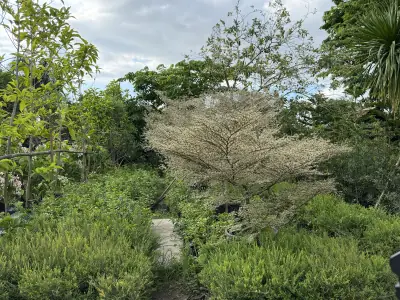
A rare cultivar of the same species develops pink, white, and green variegated foliage. Slower-growing and significantly more expensive than the green species, it is specified as a single architectural focal point for HNW residential and boutique resort projects rather than volume avenue plantings. See the Variegated Talisay page for pricing and specimen sourcing on the cultivar form.
Planting & Establishment
Site Preparation
- Dig hole 2-3x the root ball diameter
- Amend heavy clay soils with organic matter
- Ensure drainage. Add a gravel layer if needed
Planting
- Set tree so root flare is at or slightly above grade
- Backfill with a mix of native soil and compost
- Create a water basin around the tree
- Mulch with 3-4 inches of organic material, keeping mulch away from the trunk
First Year Care
- Water deeply 2-3 times per week during dry season
- Stake if in a windy location (remove stakes after one year)
- Do not fertilize until the tree is established (6+ months after planting)
For B2B and avenue-planting projects, we provide the planting service end-to-end including crane installation for specimen-grade trees.
Ongoing Maintenance
African Talisay is genuinely low-maintenance once established:
- Pruning: minimal required. Only remove dead, damaged, or crossing branches. The tree naturally maintains its tiered form.
- Fertilizing: annual application of balanced slow-release fertilizer (14-14-14) in early wet season.
- Pest/Disease: generally healthy. Occasional mealybug on young growth, treat with insecticidal soap if significant.
- Leaf drop: normal during extended dry periods. Tree will recover with rain.
Sources
Footnotes
-
Plants of the World Online (POWO), Royal Botanic Gardens, Kew. “Terminalia mantaly H.Perrier.” Accessed 2026. https://powo.science.kew.org/ ↩
-
National Parks Board Singapore. “Terminalia mantaly.” Flora & Fauna Web. Accessed 2026. https://www.nparks.gov.sg/florafaunaweb ↩
We plant and install this
Halamanan supplies and installs African Talisay as part of our landscape design and landscape construction projects. We source the plants, place them in the design, and plant them with the rest of the garden.
Sourcing & Supply
Origin
Direct from established Philippine nurseries with verified Terminalia mantaly stock. We do not substitute Terminalia catappa (native Philippine Talisay), which has different growth habit, form, and leaf morphology. Mantaly is identified by its tiered horizontal branching and clustered obovate leaves at branch tips.
Supplier Relationship
Long-term relationships with 4-6 specialist tree nurseries across Luzon. We pre-inspect specimens for form quality (well-developed tiered branching), trunk caliper, and root ball condition before transport. Field-grown vs. container-grown noted explicitly in every quote.
Quality Control
Each tree photo-documented for trunk caliper, tier development, and root ball before delivery. Specimen-grade trees (14-16 ft) include a pre-delivery video inspection on request. 30-day establishment guarantee covers nursery-side issues; replacement provided if a properly-installed tree fails within 30 days.
How to Order
- 1
Inquiry to Quote
Send us your specs and project size. We respond with a project-specific quote within 24 hours.
- 2
Site Visit / Spec Confirmation
For larger projects, we coordinate a site visit or spec call to confirm requirements.
- 3
Order Confirmation + Deposit
50% deposit confirms your order. Established institutional accounts may qualify for net terms.
- 4
Production / Sourcing & Delivery
We coordinate sourcing, production, and delivery. Final payment due on delivery.
- Response time
- We respond within 4 business hours.
- Payment terms
- 50/50 standard. Net terms available for established institutional accounts.
- Documentation
- Sales Invoice, Delivery Receipt, COA-compliant documentation on request.
Frequently Asked Questions
How much does African Talisay cost in the Philippines?
Tree-only pricing ranges from ₱5,500 for 6-7 ft landscape-grade specimens to ₱11,500 for 14-16 ft maximum-sourced trees. Delivery, planting, and establishment service are quoted separately per project. Volume discounts apply at 10+ trees (5%), 26-50 trees (8-10%), 51-100 trees (12-15%), and 100+ trees (project pricing).
Do you offer volume discounts for avenue plantings?
Yes. Avenue and boulevard plantings typically order 50-200 trees and qualify for the 8-15% bulk tier. For projects above 100 trees we provide custom project-specific pricing including coordinated delivery, planting schedule, and 30-day establishment guarantee on the full batch.
Is delivery and installation included in the price?
No. The listed pricing is tree-only. Delivery, crane installation (required for 14-16 ft specimens), planting, and the 30-day establishment service are quoted separately based on project location and access. Standard CALABARZON delivery is included for orders above ₱100,000.
How fast does African Talisay grow?
Once established, expect 0.5-1 meter of height gain per year under full sun and adequate water. Growth is faster in the first 2-3 years and slows as the tree matures. Trees in partial shade grow leggy and lose the compact tiered form.
Will the roots damage my building foundation?
Maintain a 3-meter minimum setback from structures. The root system is not particularly aggressive, but any large tree planted too close to foundations can cause issues. For paved areas, consider root barrier installation, which we can include in the project quote.
Why might my African Talisay not develop the signature tiered form?
Almost always insufficient sunlight. Trees in partial shade grow leggy and lose the compact branching pattern. Other causes: over-fertilizing (promotes soft, vertical growth) or incorrect species substitution (Terminalia catappa is sometimes sold as 'Talisay' but does not develop the same form).
Where do you source your African Talisay trees?
We work with 4-6 specialist tree nurseries across Luzon. Each tree is field-verified as Terminalia mantaly (not catappa), pre-inspected for form quality and root ball condition, and photo-documented before transport. Provincial sourcing is available for projects in Visayas and Mindanao with adjusted lead times.
Is it really from Africa?
The common name is misleading. Terminalia mantaly is native to Madagascar, an island nation off Africa's east coast, not mainland Africa. The species is sometimes called Madagascar Almond, Umbrella Tree, or Satellite Tree. True African Talisay would be Terminalia catappa, a different and more common coastal species in the Philippines.
What spacing should I use for an avenue planting?
Standard avenue spacing is 6-8 m on center for 8-10 ft trees, allowing the canopies to meet at maturity for continuous shade. For formal boulevard plantings with intentional canopy gaps, 10-12 m spacing is used. We recommend 8 m as the default for most corporate and resort projects.
Is African Talisay safe to plant near a swimming pool?
Yes. African Talisay is pool-safe. Minimal leaf drop, no messy fruit, and roots are not aggressive toward pool structures within the recommended 3 m setback. The tiered branching also provides high overhead shade without dropping debris into the water.
What's the typical lead time for an order?
Standard lead time is 2-4 weeks for orders up to 25 trees, depending on form selection requirements and current nursery inventory. Avenue plantings of 50+ uniform specimens typically require 4-6 weeks lead time to allow form-matching across the batch. Project-specific schedules confirmed at quote stage.
What does your 30-day establishment guarantee cover?
If a properly-installed tree (planted by us or per our written planting protocol) fails within 30 days due to nursery-side issues. Root ball damage, undisclosed disease, or transport stress. We provide a free replacement. Failures from improper post-planting care, weather events, or vandalism are not covered. Standard for all B2B orders.
Ready to spec African Talisay for your project?
Send us your project details. We respond within 4 business hours.